
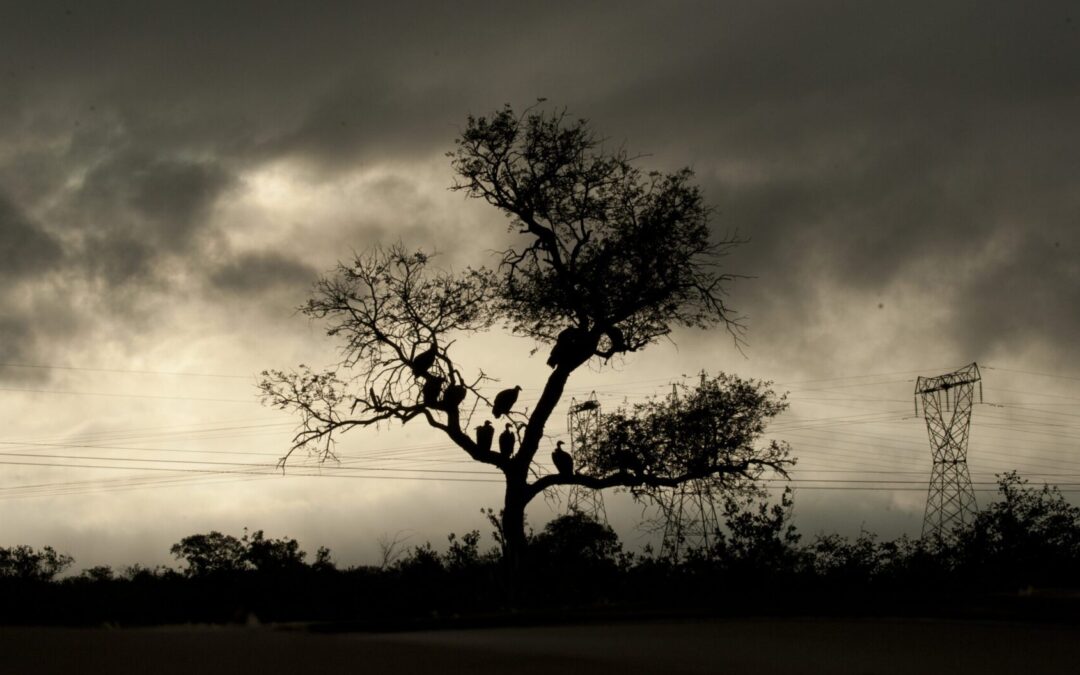
It’s widely acknowledged that power lines can be dangerous, but a new paper has brought to light some of the challenges for vultures including emphasis on the high number of mortalities that come from contact with power lines.
In South Africa, the government owned electrical power company ‘Eskom’, admit that vulture fatalities arising from power line collisions and electrocutions represent 34% of all annual vulture losses in the country. The government have struggled to mitigate or control such devastating losses but as the continent wide demand for electricity continues its exponential rise, so the effect will likely escalate.
Not only can power lines kill from collision but they can also electrocute vultures. When a bird perches on a power line or touches it while in flight, it completes an electrical circuit, resulting in electrocution. This is especially common when power lines are not properly insulated or when birds are perched on adjacent poles or other wires. Sometimes collisions or electrocutions aren’t immediately fatal, but the birds are usually reliant on being rescued and rehabilitated – and in the majority of these rescue cases, they sustain life changing injuries and are not able to be released.
The impact of power lines on vultures has been particularly devastating in South Africa. The country is home to a significant population of vultures, including endangered vultures such as African white-backed vultures (Gyps africanus) and Cape vultures (Gyps coprotheres), which have suffered a 90% decline in numbers over the past century. The other vulture species found in South Africa are also at risk, with some populations declining by as much as 80%.
Despite efforts, the problem persists and vulture populations continue to decline. The challenges of protecting vultures are complex and require a multifaceted approach. In addition to addressing the threat posed by power lines, conservationists must also tackle issues such as habitat loss, poisoning, and illegal hunting.
Ultimately, it is the responsibility of all stakeholders, including power companies, governments, conservation organisations and the public, to work together to protect vultures and ensure their survival. By taking a collaborative approach, we can help to prevent the extinction of these magnificent birds and preserve their essential ecological function.
